Independent field benchmark · fully logged

You're paying for the expensive tier.
The data says you shouldn't.

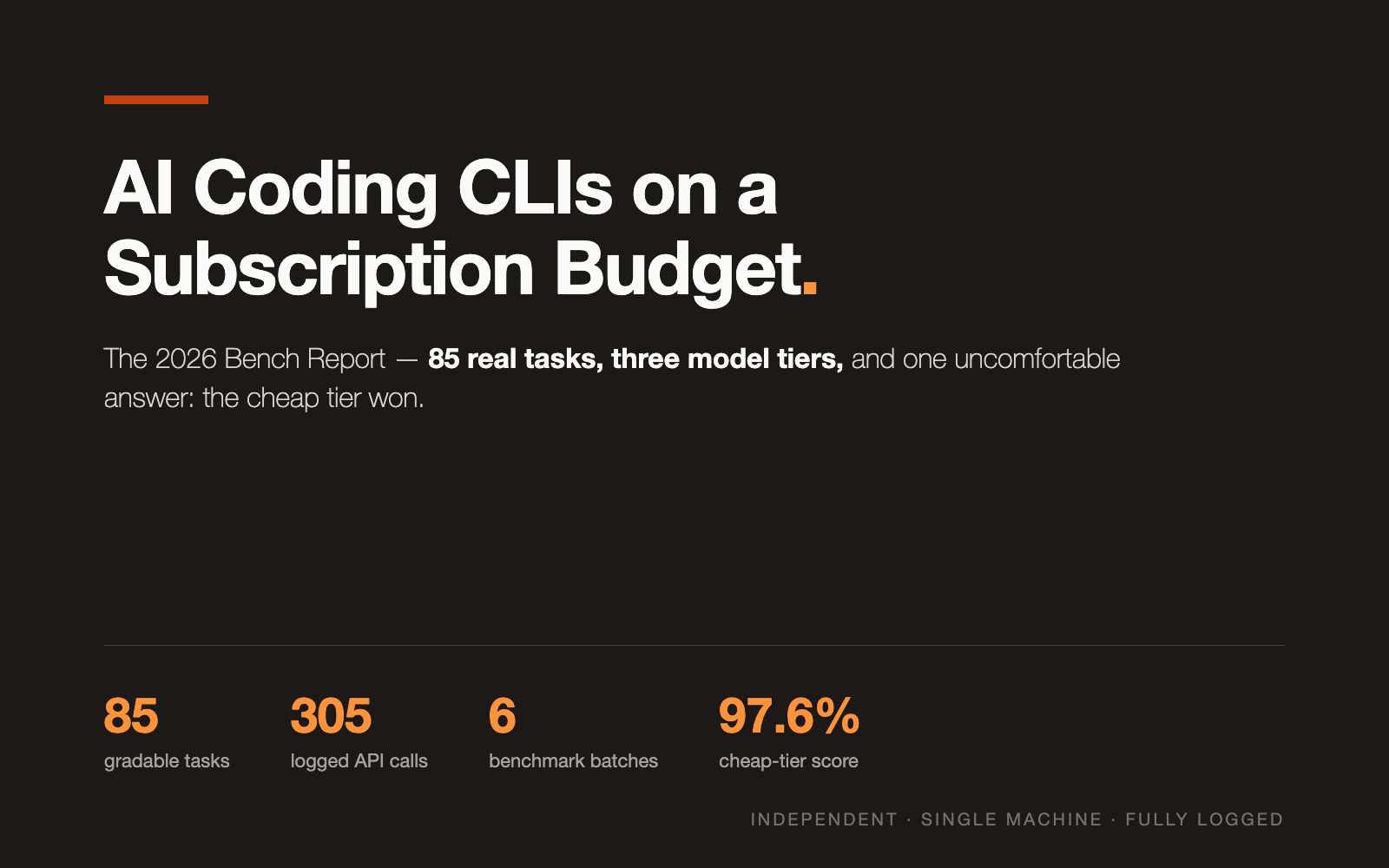
85 real coding tasks, three model tiers, 305 logged API calls. Every number traces to a raw run JSON. The cheap tier won — and not by a little.

Get the report — $14.90 Read the free sample $18.60 launch week $11.92 with code LAUNCH20
The 2026 Bench Report cover
PDF + EPUB · 10 chapters + 3 appendices · ~35 pages
97.6%
cheap tier score (83/85)
94.1%
expensive tier score
305
logged API calls
0
problems where expensive won

What the data says

This is a field benchmark, not a vendor slide deck. One operator, one machine, the same model family at three settings, graded by executing the code — not by reading it.

01

The expensive tier scored lower, ran slower, cost more

thinking:high scored 94.1% vs 97.6% for the cheap setting, ran 25–52% slower, and burned 24–46% more tokens. Across six batches, not a single problem where the expensive tier genuinely won.

02

Small models don't die on hard problems

"Hard with a known recipe" — lock ordering, decorators, deque tricks — the small model passes at 80–100%. What kills it is medium no-template work: regexes, CSV quoting, constraint lists. Twenty medium problems. It passed four.

03

The scariest failure doesn't show in any score

Asked to patch a working slugify, the small model met the new requirement and silently dropped the old behavior — slugify('Hello World') returned 'helloworld'. Clean code, invisible at review, caught only by running tests.

04

A decision tree that erases the tier gap

Which tier for which task type, plus three prompt/config rules that close the gap entirely. Take the tree, keep your subscription money.

The headline matrix

Six programmatic batches, one blind-knowledge track, graded by execution. Ambiguous problems removed from the denominator — publicly, with a paper trail.

ConfigOverallLatencyTokensVerdict
glm-5.3 · thinking:low83/85 = 97.6%baselinebaselineRun this by default
glm-5.3 · thinking:high80/85 = 94.1%+25–52% slower+24–46% morePay more, get less
glm-4-flash47/85 = 55.3%fastestcheapestFine with a verification step

Free sample — read before you pay

Chapters 1, 5, and 9: the executive summary, the small-model failure map, and the decision tree. No email required.

Chapter 1 · Executive summary

Three paragraphs if that's all you read

I ran 85 gradable coding tasks (plus 10 multi-turn patch jobs and a blind-knowledge track) through the same model family at three settings. The cheap setting won. Not one problem across six batches where the expensive tier genuinely beat it.

The interesting result is where flash dies. It isn't on the hard problems — it passes the classic interview material at 80–100%. What kills it is medium-difficulty work with constraints that have no template. The failure mode isn't stupidity; it's that flash skims the constraint list the way a tired senior skims a ticket at 6pm.

And the failure that should scare you doesn't show up in any single-run score: the model you trusted to patch your code un-patches something you already shipped. The code looked clean. Only running the tests caught it.

Chapter 9 · The decision tree
You have a coding task. Start here.
│
├─ One-file script, function, or small tool?
│   └─ YES → cheap tier (thinking:low). Medium-and-below was 100% here.
│
├─ Hard refactor, multi-constraint concurrency, gnarly logic?
│   └─ Still low. Hard tier: 94%. Expensive costs more, runs slower, scored worse.
│
├─ Some rule forces you onto the high tier?
│   └─ Add: "Output a single complete code block only."
│
└─ Batch work on a small model?
    └─ Never without a verification step.
Pricing

If the data doesn't change how you configure your tools, email within 30 days for a full refund.

Sample edition
$9.90
Chapters 1, 5, and 9. For the skeptical buyer.
  • Executive summary
  • Small-model failure map
  • The decision tree
  • $9.90 back as coupon SAMPLE2FULL on upgrade
Get sample
Team pack
$39
5 seats + the raw batch ledger CSV. For eng managers.
  • Everything in the report
  • 5 seats for your team
  • Aggregated batch ledger CSV (no prompts)
Get team pack

FAQ

Is this a leaderboard crowning one vendor?

No. It tests one model family at three settings with full methodology. The findings generalize about tiers and verification habits, not brand rankings. What wasn't tested is labeled UNTESTED, not hidden.

How were the tasks graded?

By execution. The grader extracts the code block and runs it — behavior checks, not string matching. Every grader passes a two-way self-check before grading a batch, and every non-PASS gets human review.

Who is this for?

Developers and eng managers choosing AI coding tools or tiers, benchmark-curious engineers, and anyone burned by "it looked right."

Can I sell this to my audience?

Yes — we run a 40% affiliate program through Gumroad. See the affiliate page.